Announcement

Collapse
No announcement yet.

ETNZ Question

Collapse

Zenm Tech Pte Ltd

Collapse

Visit Zenmtech at rc.zenmtech.com

X
 
  • Filter
  • Time
  • Show
Clear All
new posts

    ETNZ Question

    Hi all, i'm new to RC Sailing and this is the first boat i've built.

    I noticed that the main sheet (the main sail control line) tends to get entangled easily in the winch servo drum. This happens when you sheet out too much, there is excessive slack in the line and when you sheet back in, the line may get entangled below the servo drum, where the servo axle is.

    Is there anyway to counter it?

    I want to put the plastic cover over the winch drum but its a too tight fit. The winch drum cannot rotate under the plastic cover. I've bought some fishing line weights which i'm going to attach to the main sheet and the jib sheet, and experiment to see if it can weigh down the excess slack. But i think that this will reduce the sailing performance, like for the sail to luff up in light winds.

    What do you guys advise?

    Thanks in advance!

    Terry

    #2
    Dear Terry,
    Either you use a smaller drum or artificial tensioning...try a rubber band. As you sheet in the rubber band attached to the line wiill keep the line from running around like spagetti. When you sheet out, the rubber band will "pull the line out.
    This should solve the problem when there is no wind to provide tension.
    Cheers!
    Planes: Cap21, Northrop F5E, MK Kingbird, MK Curare, Elster, Jazz60, SouthernX, Zoom 4D

    Comment


      #3
      woot new sailor ?
      [B][U][SIZE="5"][SIZE="4"][COLOR="Magenta"]As[/COLOR] [COLOR="Red"]Long [/COLOR][COLOR="DarkOrange"]As[/COLOR] [COLOR="Yellow"]They[/COLOR] [COLOR="Cyan"]Have[/COLOR] [COLOR="Lime"]Wings[/COLOR], [COLOR="Blue"]I'll[/COLOR] [COLOR="Black"]Fly[/COLOR][COLOR="DarkOrchid"]Them[/COLOR][/SIZE][/U][/B] [/SIZE][SIGPIC][/SIGPIC]

      Comment


        #4
        cum join us for the sailing.well can look out for each other boat
        mike

        Comment


          #5
          Hi, I got your solution to the unwinding trauma you got... I think you need to use the method describe here : No pictures, just imagine.. other than that, you can meet me over the weekend to check out my setup.

          OK, now picture your boat sitting in front of you, bow to the front, stern towards you.

          Your winch is sitting in the middle of the boat.
          Winch control set to center of stick controller, neutral position.
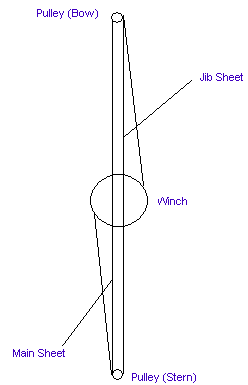
          You need to place 2 pulleys on to the front of the pulley, one to the back. try to space these 2 pulleys far apart. Distance should be longer than what your main sail boom would extent its line out to full jib.
          Run a long line from the winch, starting from the upper winch hole, run the line around the winch 1 turn clockwise and then to the front pulley then back straight through the rear pulley and then back up to the winch and go in the same clockwise direction 1 turn on the lower hole, tie a dead knot.

          Now try moving the winch to max and min and you should see that the lines will be feeding in a clockwise or anticlockwise direction like a conveyor belt.

          at the long end of the string between the 2 pulleys, tie both jib and mail line to it... so as it draws the conveyor strings in and out , your sail lines will get pulled and releases..
          I'm Remotely Controlled ...

          Comment


            #6
            I didn't promise anything, but here goes...

            Pulley, you can use anything for it... you can get 2 round plastic rod / post and stand it upright.. like a lamppost.. then run the line around it.. slap some grease on the entire conveyor lines. I used metal hinges for the pulley.

            Make sure the EndPoints for the winch is set so that the knotting points for the main sail and jib knots do not get over the pulleys.. if you cannot get enough travel for the sails boom to to full, do not adjust the end point further - the problem is the pulleys are not far apart enough..

            In that case, you need to re-position the pulleys further and re-run the new conveyor...


            I spent 1 hour figuring out this idea.. so take patience..

            Please mention my name if you want to share this with someone else .. whahaha.. I dont get commission from this..
            I'm Remotely Controlled ...

            Comment


              #7
              Hello guys, thanks for the replies! Esp to blueangel for his effort, did you think of that yourself? Your solution is indeed quite out-of-the-box, haha.

              Blueangel, i spent some time digesting your explanation, but i still don't quite get it. From the orientation of the diagram, let's say if i want to sheet in the main sail, the winch will turn in an anti clockwise direction (the green arrow) right? This will pull the mainsheet further into the hull, as the conveyor belt moves the knot up towards the first pulley near the bow.

              Make sense so far, but won't this cause the jib to sheet out? Since the knot will move closer towards the hole where the jib sheet exits the hull. So from my understanding if the knot is in the middle of both "holes", moving the conveyor belt will sheet in the main sail, while sheeting out the jib, or vice versa.

              The other way i think is to make something like a sausage between the two pulleys. Attaching the mainsheet to one line, and the jib sheet to the other line. Thus when the conveyor belt is turned, both the jib and the main saill can sheet in or sheet out at the same time. Take a look at my attachment.


              Blackite: I might want to try your rubberband suggestion. Do you mean tying one end of a rubber band to the main sheet, and let it go round the drum, and the other end glue it to the roof of the hull? Or glueing the entire length of the rubber band to the main sheet itself. In this case, do we stretch the rubberband when glueing it?

              Thanks for your suggestions once again! I'm still in army now so don't think i'll get a chance to read your messages once again. Thanks!

              Comment


                #8
                Does this makes sense now ?

                Cannot everything teach you lah.. must let you think mah.. but can see that you been cracking out your brain huh ?

                Its simple actually, extra pulley to reverse the direction.


                Cheers... !~
                I'm Remotely Controlled ...

                Comment


                  #9
                  ah! ingenious! Why didn't i think of that... *smacks head*

                  I was thinking we can use the two existing "poles" inside the hull as the pullies? The rod where you insert the keel screw into, and the rudder screw rod. Not sure if they're spaced wide apart enough though!

                  Thanks for the inspiration guys!

                  -Terry.

                  Comment


                    #10
                    You don't need a very long distance.. just measure the distance from deck to boom ( where the strings runs from :- the deck hole to the boom where you tie the strings to ) and add about 3 cm to it... that 3 cm probably can get you alot of adjustment plays to your setup, and still be conservative of the pulley distance apart. Don't bother getting too deep inside the hull, not easy to reach if anything screwed up inside there though.. just my 2 cents.


                    I read your ETNZ instruction sheets... they look craps to me on that winch setup... one look can tell its going to eat up alot of noodles like that...
                    I'm Remotely Controlled ...

                    Comment

                    Working...
                    X