If this is your first visit, be sure to
check out the Rules and Help. You may have to register
before you can post: click the register link above to proceed. To start viewing messages,
select the forum that you want to visit from the selection below.
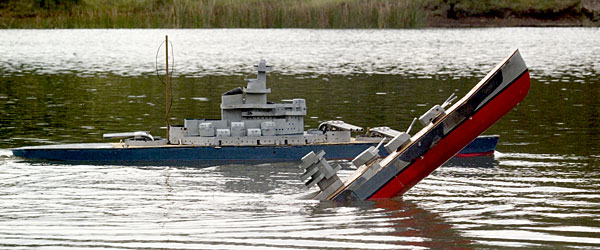
Do the vessel really sink ?
They certainly do! The vessels are skinned in thin balsa, when that balsa in penetrated they start to take on water. When the inflow of water is greater than the pump can handle, the ship will start to settle and eventually sink if not returned to port promptly. In most battles at least one vessel will sink as the vessel floods too fast to get home, stays at sea too long or suffers some sort of systems failure which prevents it from returning to port.
How do you recover a sunken vessel ?
Each vessel carries a float which is attached to the vessel's hull by a long line. When the vessel sinks, the float will (normally) pop to the surface, bringing one end of the line with it. As the other end is securely attached to the hull, pulling in the line will retrieve the vessel from the depths. Sometimes the float does not fully deploy or the line is too short and the vessel has to be dragged for. No vessel in the AusBG has ever been permanently lost and vessels have sunk in water more than 20 feet deep.
Does sinking damage the vessel ? Mainly no, but sometimes yes. These vessels are purpose built for this hobby and the builders take into account that everything inside the vessel will sometimes get very wet. Although there are many systems inside a combat model, most don't really care if they do get wet. The cannon don't care, gel-cell batteries don't care, the motors don't care, the pump doesn't care. Essentially it is the radio control gear that is at risk but modern radio control gear is very tough. While people in this hobby used to go to great lengths to try and keep their gear dry, most do not bother these days and just cut holes in the servo cases to allow the water to drain out. When the servos get wet, they become unreliable, so they are normally placed high in a vessel, but when the vessel is recovered after sinking, the servos drain, dry out and return to normal. Everyone protects their delicate radio receiver though, normally inside a tough balloon with the neck sealed with blue-tack and a cable tie.
Despite this, every so often a servo will strip a gear or blow a circuit board and will need to be replaced, but this is rare and the standard servos we use are quite cheap so it is no big deal. Provided a vessel and its gear has the water drained quickly after the battle and the servos and cannons are flushed with methylated spirits and stored dry between battles they normally will give years of reliable service.
If I am not wrong, its illegal to do that in Singapore..A few months ago some1 brought some BB guns (the one for model warship combat) into Singapore, got caught...Although I don't think the pellets should hurt anyone, read from somewhere that impact is like that of paintball, at the most, it leavers a small bruise.
Hangar:
IJN Yamato (RC, EP)
fitted with workable searchlight
1/350 Tamiya,
converted from static
DKM Bismarck (Static)
USS Missouri (Static)
--------------------
Shipyard:
Schnellboot S-100 Klasse (RC, EP)
USS New Jersey (RC, EP)
-------------------
Home Waters: Tanah Merah (my condo)
Boating hours: 9.30pm+ (night ops)
-------------------
Comment