Announcement

Collapse
No announcement yet.

Windrider Bee2

Collapse

Zenm Tech Pte Ltd

Collapse

Visit Zenmtech at rc.zenmtech.com

X
 
  • Filter
  • Time
  • Show
Clear All
new posts

    Windrider Bee2

    Well, I've been trying to fly my Nutmeg glider at our local slope, but without a lot of success. The Nutmeg flies very well, but my poor landings require a much sturdier model.

    So I hauled out my Chinese EPO Phoenix 2000 and threw it off the side of the mountain. Fought it all the way to a landing in a tree. I know that many people like this glider but I get bad vibes from it and consider it to be of very low quality. But it was cheap!

    So... it was suggested to me (by the designer of flying wings made in Britain), that I consider a cheap flying wing glider ie the Windrider Bee 2. Apparently it is almost indestructible and quite easy and forgiving for a complete novice like me to fly. However nobody at my site has flown one or even seen one.

    Are there any opinions and experiences with this model that somebody would like to share. I need all the help I can get in order to decide what my next step should be.

    Thank you in advance.

    Ian
    in Japan

    #2
    Hi Ian,

    The Bee2 is a goood model for any slope, its made up of fairly tough foam and you can tape a few rounds of fiber tape around to protect it if your slope is rough with rocks. As with any flying wings, the CG is very important, so try get it right before you toss it off. Once you get the CG spot on, its a good floater.

    There is also the beevolution which has a speedier profile but less floaty. And also the bigger wing span 60inch scout bee. The bigger scout bee due to the larger wing area is more efficient and you can fly it further out without losing visiblity.

    Windrider's range of flying wings are hardy and can take abuse, most of us have one of these for combat at the slope. They can take hits no problem.

    If your slope is mainly light-medium lift like ours, you may also like to consider Alula or Weasel , both are suitable for novice, compact, portable and provide lots of fun.
    www.facebook.com/groups/BRslopers
    www.facebook.com/groups/SG.Fr3aK.League

    Comment


      #3
      +1 to what Pang said. Great advice and spot on. Other then getting it caught in a tree you can't climb it's practically impossible to kill an EPP flying wing and the Bee is one of the top specimen. I'm also a huge fan of the Alula which seems to be capable of flying on butterfly farts as well as it's acrobatic brother the Weasel. Both of these models can break down to fit into their original small blue box and are extremely portable.


      One thing you may be experiencing with the Phoenix 2000 is that it does not have polyhedral wings like the Nutmeg and so it does not have a built in tendency to fly level. Polyhedral wings are noticeably much more stable and even if it had ailerons it would be rather difficult to get it to roll. With the Phoenix 2000 the main turn maneuvering is done with a mix of aileron and elevator not rudder and elevator (technically a mix of aileron, elevator, & rudder is the best but you can forget about mixing in the rudder at this stage). Because of this the flying characteristics will be much different and the Phoenix will feel a lot looser until you get used to correcting it's roll and leveling out it's flight path after each turn. Also ailerons tend to be a lot more sensitive and need less stick movement than most rudders. Until you get used to aileron control you may want to reduce their throws if they feel too sensitive.

      Ian, what kind of Tx do you have (i.e. brand and model)? I do not know how you have it set up or what type of mixing control you have but what a lot of people do when they fly a plane which only has Rudder Elevator controls is they set up the rudder on what would normally would be the aileron control, or the main"turning stick" on the Tx. To do this they simply plug the rudder servo into the ailerons slot on the Rx. When switching to an aircraft that has ailerons the rudder gets demoted back to it's normal stick, and ailerons are flown with aileron. If you are flying your Nutmeg in mode 4 with the rudder on the actual rudder stick and not the aileron stick and are most comfortable flying this way, you might consider setting up the ailerons on the Phoenix to the rudder stick and moving the rudder to the aileron stick. A bit confusing and 100% guaranteed you can't hand your Tx to someone else and expect them to fly it, but in your case do whatever works and is most comfortable for you. (Disclaimer: messing around with what stick does what might limit or confuse the mixing set ups for some Tx's)

      The reason I got into the Rudder vs Aileron thing is that a flying wing such as the Bee is also aileron (well actual elevon) and so you will still need to adjust to flying with ailerons and a non polyhedral wing. That said, since you will no longer have to worry about crashing it and breaking it, it will be a great trainer and a fun plane all around even after you master it.

      Why I asked earlier what Tx you had, is because the Bee will require mixing. Most Tx's should have this capability and if you can not find it in the glider programs as a flying wing, you should be able to find it in the power section under delta wings which are basically the same thing.

      Sorry for the long post, and forgive me if it comes across as too elementary. Not knowing the extent of your knowledge or experience I'd hate to assume too much and skip something small which could help make a difference. Keep it up and you will be greatly rewarded! I can't think of anything more peaceful and fun then flying a glider.

      Cheers!

      -Jonathan
      Last edited by Twyl; 11-09-2012, 08:33 AM.

      Comment


        #4
        ...
        Last edited by Twyl; 11-09-2012, 08:34 AM. Reason: Edited original post

        Comment


          #5
          Hi Ian

          I too started with a wrong footing for my first slope glider which ends up disaster.
          Yes, I would highly recommend flying wings. A part from learning to slope, if you have more of your friends with wings, you can do combat which you will never do with a powered glider or plane. Lots of laughter and don't forget not to miss identify your wing.

          2 years ago I had windrider bee2, combat with some of my buddies, laugh so hard that miss identified bee2 and ends up on very high tree. It was it's home for the next 1 year.

          Comment


            #6
            Thank you all for such constructive advice in reply to my enquiry.

            After reading your replies I ordered a Windrider Bee2 from Hong Kong and should have it in my hands in a few days. I'm rather afraid of damaging my Nutmeg and get really bad feelings from the Phoenix 2000 so I hope the Bee will bring a degree of carefree enjoyment back to my learning how to fly. If I can keep the Bee in close at first, and dorking it into the slope to land won't really hurt it, then maybe I can begin to master the art.

            I use a JR XG8 transmitter so that its easy to change stick mode in the software. At the moment it is set up for mode 4 with rudder and elevator on the right stick and spoiler on the left. Elevon and V-tail mixing is also in the software and should be no problem to enable and use. Elevator and rudder/aileron on the right stick seem most natural and instinctive for me, but everybody is different. Don't worry about telling me elementary or obvious things, that's the kind of help and advice I need and greatly appreciate.

            Well, now I must wait for the postman. I'm really looking forward to receiving the Bee 2. Simple and strong should fit my needs exactly.

            Thank you again.

            Ian
            in Japan

            Comment


              #7
              Ian

              The bee2 is able to take std servos. I think you should look at this option. My ex-bee used HS65 which have enough torque for the control but it a bit too light and I had to put quite a bit of nose weight even with 4cells NIMH 2500mah. If I am not mistaken, the given CG is also off, way off the point is not even on the wing... hmm or is that my scout bee... haha

              Bee2 is a bit more floaty due to thicker airfoil. If you combating or chasing bevolution or the scout bee, you may find it a bit slow in speed but it's very good in climbing and tight turns. It pick thermal or updraft pretty good too.

              Comment


                #8
                Not forgetting we aerotow these 60" flying wings during off-seasons.

                Attached Files

                Comment


                  #9
                  chiadennis,

                  I note very carefully all the excellent points you have made about the Bee 2. Sorry to read that you lost yours in a tree for so long that it disintegrated. From your posts I gather that you really enjoyed flying your Bee and I hope that I will be able to enjoy mine as much. Its good to hear that the Bee is not very fast, that should suit me just fine.

                  Joe Yap,

                  Great photos. Do the flying wings lift off from a detachable dolly of some kind? Is that what I can barely see at the bottom of the second photo?

                  Ian
                  in Japan

                  Comment


                    #10
                    Originally posted by Forbes View Post
                    Thank you all for such constructive advice in reply to my enquiry.

                    After reading your replies I ordered a Windrider Bee2 from Hong Kong and should have it in my hands in a few days. I'm rather afraid of damaging my Nutmeg and get really bad feelings from the Phoenix 2000 so I hope the Bee will bring a degree of carefree enjoyment back to my learning how to fly. If I can keep the Bee in close at first, and dorking it into the slope to land won't really hurt it, then maybe I can begin to master the art.

                    I use a JR XG8 transmitter so that its easy to change stick mode in the software. At the moment it is set up for mode 4 with rudder and elevator on the right stick and spoiler on the left. Elevon and V-tail mixing is also in the software and should be no problem to enable and use. Elevator and rudder/aileron on the right stick seem most natural and instinctive for me, but everybody is different. Don't worry about telling me elementary or obvious things, that's the kind of help and advice I need and greatly appreciate.

                    Well, now I must wait for the postman. I'm really looking forward to receiving the Bee 2. Simple and strong should fit my needs exactly.

                    Thank you again.

                    Ian
                    in Japan
                    Ian, nice Tx. I hadn't really given it much thought, but mode 2 and mode 4 are pretty much the same with the only difference being the position of the rudder and aileron. From the sound of things, I think you would be comfortable flying mode 2 with an aileron/elevator ship and mode 4 with a rudder/elevator ship. I guess the real question is which mode would you choose for a full house ship that has both rudder and aileron. Given that on a full house ship rudder is used less frequently then aileron I think you would be more comfortable with mode 2. Thats just my $0.02 so obviously go with what feels best for you.

                    Congratz on the Bee2 purchase! I hope you post some build photos. Here's some random info I've come across in regards to the Bee2.

                    CG --> 8.5in from LE
                    Differential --> None (i.e. Aileron movement "throw" should be the same up as down) If with no differential you still do not get axial rolls adjust throws so there is slightly less upward movement then down. Note: Differential for flying wings or planks is opposite than that of standard layout gliders/planes.
                    Elevator Throw --> Should be less then aileron
                    Winglets --> Larger winglets then provided can help provide better stability (i.e. about 1-2in longer then TE)


                    Cheers!

                    -Jonathan
                    Last edited by Twyl; 22-09-2012, 12:18 AM.

                    Comment


                      #11
                      Originally posted by Forbes View Post
                      chiadennis,

                      I note very carefully all the excellent points you have made about the Bee 2. Sorry to read that you lost yours in a tree for so long that it disintegrated. From your posts I gather that you really enjoyed flying your Bee and I hope that I will be able to enjoy mine as much. Its good to hear that the Bee is not very fast, that should suit me just fine.

                      Joe Yap,

                      Great photos. Do the flying wings lift off from a detachable dolly of some kind? Is that what I can barely see at the bottom of the second photo?

                      Ian
                      in Japan
                      Hi Ian,

                      Yes, the Scout Bees take off from a self-made dolly. Also, we use velcro as the attachment at the end of the towline. To release the Scout Bees, it just need to pull some 'up' elevator while the tug is doing a shallow dive.

                      Comment


                        #12
                        The box with my Bee2 in it turned up from Hong Kong yesterday. Today was a holiday for me so I was able to complete over half of the assembly, the balance will be done tomorrow. The weather forecast is for rain, cloud, and almost no wind, so I'll be better off happily constructing and setting up the Bee in the comfort of my home!

                        Nothing much to photograph unless anyone is interested in seeing the application of strapping tape. Pretty boring, but necessary. The servos fit perfectly into the cutouts and I intend to use some strong double sided tape or silicone to hold them down at the bottom of the holes. The hole for the receiver is rather short but I believe I can lengthen it 5-7 mm by cutting out the foam.

                        Overall my impression is that a lot of thought and testing has gone into the manufacture of this kit, despite the rather poor and incomplete instructions.

                        When the Bee is completed, and before I crash it, I'll take some photos.

                        I'm really looking forward to being able to relax and enjoy whilst I learn how to fly. The Bee certainly seems to be strong and light.

                        One question - where is the neutral position for the elevons? Level with the bottom of the airfoil?

                        Thanks Twyl, for the initial set up and throws.

                        Ian
                        in Japan

                        Comment


                          #13
                          Hi Ian,
                          In general for wings the bottom of the elevon should follow the line of the bottom of the wing. When looking at it from above, it might appear there is a little reflex in the wing, but that should be ok.

                          I'm sure your Tx has dual rates and maybe even triple rates. If I were you I would set my high rates based on maximum aileron movement making sure to tweak the settings in your Tx so that both aileron moves the same distance up and down on both sides of the wing. Set your elevator high rates to about half of the aileron movement. For low rates set both aileron and elevator to maybe 60-65% of high rates. Maiden it using low rates and adjust to what feels comfortable for you from there.

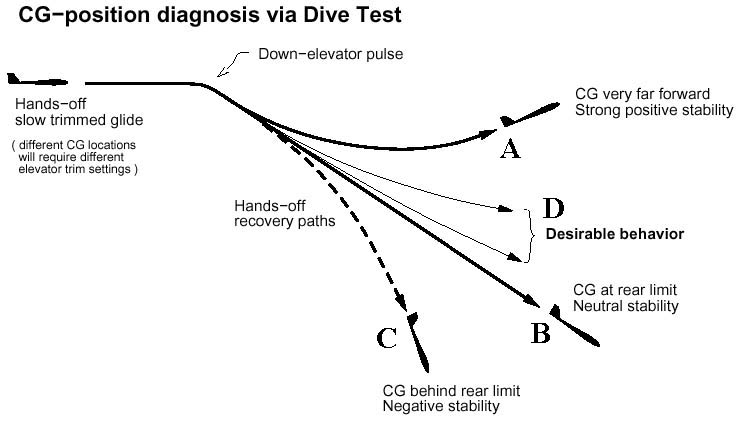
                          Once you get it flying and get some altitude perform a dive test to confirm the CG. Try to aim for option B in the picture below. What it claims as the desired reaction (D) is applicable for thermal gliders, but for slope planes which tend to fly faster and are more aerobatic it is more desirable to be able to point them in a direction and have them maintain that angle instead of ballooning up.

                          Click image for larger version

Name:	a4811245-92-cg-position-divetest.jpg
Views:	1
Size:	45.8 KB
ID:	972229

                          -Jonathan

                          Comment


                            #14
                            Well I completed my Bee2 and took it out to a nice grassy field to hand launch and see if it really flies! It did, after a little up elevator was added.

                            Turn control is yet an unknown as there was not enough time in the air from launch to land to try that out.

                            Thank you Twyl for your suggestions on the control throws, that really helped me out.

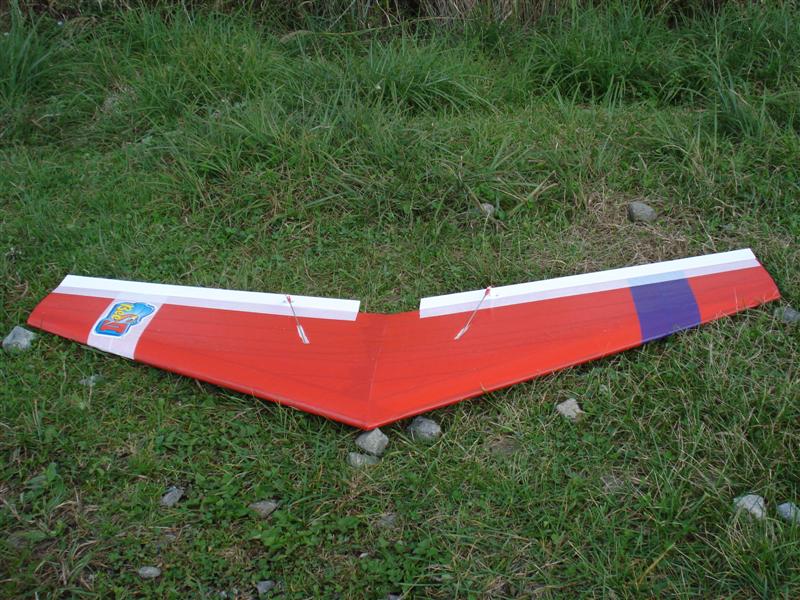
                            Total all up weight came out to 660gm (23.3oz) which is probably a bit heavy, but it is strong. I had to put 45gm of lead under the battery to balance at 8.5in. back from the front. I'm confused because this is 17.5in measured back along the leading edge but the "instructions" state 14in. along the leading edge from the nose. That would require an awfully large lump of lead in the nose to achieve, and I feel that it would be like trying to fly a brick. But, as a beginner what do I know?

                            Today is pouring rain, so no flying...maybe next weekend. I really want to throw the Bee off the mountain and see what happens!
                            Click image for larger version

Name:	DSC00876 (Medium).JPG
Views:	1
Size:	130.0 KB
ID:	972241

                            Forgot to attach the winglets for the photo, but remembered for test flights.

                            Ian
                            in Japan

                            Comment


                              #15
                              Originally posted by Forbes View Post
                              Thank you Twyl for your suggestions on the control throws, that really helped me out.

                              Total all up weight came out to 660gm (23.3oz) which is probably a bit heavy, but it is strong. I had to put 45gm of lead under the battery to balance at 8.5in. back from the front. I'm confused because this is 17.5in measured back along the leading edge but the "instructions" state 14in. along the leading edge from the nose. That would require an awfully large lump of lead in the nose to achieve, and I feel that it would be like trying to fly a brick. But, as a beginner what do I know?

                              Ian
                              in Japan
                              Congratz Ian! It's looking sharp. The low 20oz's is a good weight. Regarding the CG I can't really confirm as I don't have one to call my own, but the numerous posts i read elsewhere all concluded that 8.5" was the way to go and for some reason the manual appeared to be wrong. I've never measured or heard of a CG measure by starting from the tip and going along the leading edge, but instead it is normally measured from where the wing meets the fuse, or for flying wings the very point of the wing.

                              Your glide test sounds like it went well. You really don't need to test the turns other then maybe to reconfirm they aren't backwards or way overly sensitive. It's pretty difficult to determine much more from a hand launch in a flat field.

                              Looking forward to your first slope report.

                              -Jonathan

                              Comment

                              Working...
                              X